China Best White Thermal Transfer Labels Supplier
Choosing the China Best White Thermal Transfer Labels Supplier starts with understanding how labels will perform in your actual workflow. White Thermal Transfer Labels are widely used for product identification, inventory, shipping, and retail applications. Their print durability depends on more than a bright white surface. Facestock, adhesive, ribbon, printer settings, and storage conditions all affect the result.
A practical supplier should explain these choices clearly. Ask whether the label material suits paper or synthetic surfaces, and whether the adhesive is designed for cold, humid, or frequently handled environments. Check roll dimensions, core size, winding direction, and printer compatibility before placing a large order. Details matter. Request samples and test them on your own equipment. Look closely at barcode readability, edge lifting, smudging, and adhesion after handling. A label may look perfect on a specification sheet, yet behave differently on a dusty carton or curved container.
Reliable sourcing also depends on communication and repeatability. Confirm written specifications, sample approval procedures, production tolerances, and packaging details. If a supplier offers test reports or quality records, review what they cover rather than relying on broad promises. No single product is best for every application. Even experienced buyers may need to revise a specification after real-world trials. Test before scaling. A careful comparison of samples, technical support, and consistent production can help identify a China-based partner suited to your labeling needs.
What Are White Thermal Transfer Labels?
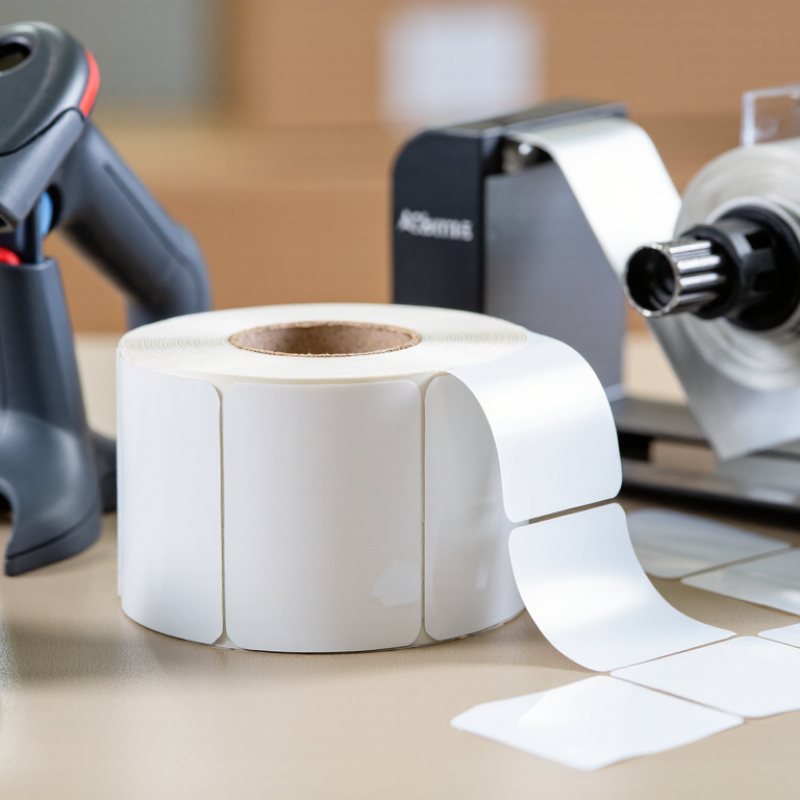
White thermal transfer labels are printable labels with a white face stock. During printing, a thermal printhead warms a ribbon and transfers ink onto the label. This process produces clear text and barcodes on paper or synthetic materials. A white background gives dark print strong contrast, helping small lot codes and shipping details remain readable. Simple, but useful. The label’s durability depends on its face material, ribbon, adhesive, and exposure to moisture, friction, or sunlight. Paper works well for many indoor applications, while synthetic stocks may better resist abrasion or damp handling.
Tips: Match the ribbon to the label stock, then test a sample at your normal print speed. Check how the label performs on cold, dusty, or curved surfaces. Make sure the adhesive stays down at the edges. A barcode may look sharp but still scan poorly if print darkness is too low. Test it.
When comparing suppliers, request clear stock specifications, roll dimensions, and sample labels. Share your printer model and intended use so the material can be assessed properly. I would not choose by whiteness alone: a bright face looks clean, but the wrong ribbon can smudge. A small trial can reveal that problem early.
How Are Labels Made and Matched with Ribbons?
White thermal transfer labels begin with a smooth, even surface. Converters coat and dry the face stock, apply pressure-sensitive adhesive, then laminate it to a release liner. Slitting and inspection follow. A tiny coating defect can leave a pale streak, so samples should be checked under the same lighting used in production.
Ribbon choice depends on the label material, printhead, and job conditions. Wax ribbons suit many paper labels; wax-resin or resin blends generally resist more rubbing and chemicals, but need compatible stock and settings. Too much heat can blur small text. Too little can leave broken lines. ISO/IEC 15416:2016 grades linear barcode print quality on a 0–4 scale, offering a measurable check beyond visual inspection. A clear-looking barcode may still scan poorly.
Match the ribbon by printing a short trial on the actual white label stock. Check edge sharpness, smudge resistance, and barcode readability after handling. GS1 barcode guidance also emphasizes quiet zones around symbols; keep these areas free of text and graphics. Start with the printer maker’s recommended darkness and speed, then adjust one setting at a time. It is easy to trust a sample roll too quickly. Recheck after changing stock, ribbon, or print speed.
Which Industries Use White Thermal Transfer Labels?
White thermal transfer labels are used across industries that need clear, durable identification. In warehouses and logistics centers, they display barcodes, carton numbers, and routing details on boxes and bins. A sharp black print is easier to scan under busy packing-line lights. Labels may also face rubbing, dust, or repeated handling, so the face material and ribbon should suit the job.
Manufacturers use them to identify components, tools, and finished goods, often through several stages of production. Food processors may apply them to outer packaging for batch codes and storage information, while healthcare facilities use them on sample containers and supply packages. The right choice depends on the surface, temperature, and expected contact with moisture or chemicals. Small details matter. A label that works well on a dry carton may lift from a chilled container. Testing a sample on the actual package is sensible, though it can be overlooked when production is rushed. Thermal transfer printing offers consistent results, but it does not make every label suitable for every environment.
What Capabilities Should a Chinese Supplier Offer?
China Best White Thermal Transfer Labels Supplier
What Capabilities Should a Chinese Supplier Offer?
A capable supplier should understand how label facestock, adhesive, and ribbon work together. White thermal transfer labels may look simple, but poor coating consistency can cause pale text or uneven barcodes. Ask for samples printed with your intended ribbon and printer settings. Check edge definition, rub resistance, and whether small text stays readable. Small details matter.
Production control is just as important. A supplier should explain how it checks coating weight, roll dimensions, core size, and adhesive performance across batches. Clear batch records help trace issues when a shipment behaves differently from an approved sample. Useful support includes custom widths, winding direction, packaging options, and realistic lead-time updates. A technically strong team should discuss storage conditions too, since heat and humidity can affect adhesive behavior.
Communication is often overlooked. A responsive supplier will ask where the labels will be applied and what surfaces they must handle, rather than offering one grade for every job. Request written specifications and a sample approval process before placing a large order. No supplier gets every detail right on the first trial. That is worth admitting. A careful review of early production can reveal problems before they reach the packing line.
China Best White Thermal Transfer Labels Supplier - What Capabilities Should a Chinese Supplier Offer?
| Capability | What a capable supplier should offer | How to evaluate it |
|---|---|---|
| White facestock selection | Options such as coated paper for general-purpose labeling and synthetic films, including PP or PET, where moisture, abrasion, or durability requirements call for them. | Request material specifications and samples; compare print quality, stiffness, surface finish, and performance in the intended environment. |
| Adhesive matching | Adhesive choices matched to the application, such as permanent or removable grades and options for different surfaces or temperature conditions. | Share the surface type, application temperature, service temperature, and exposure conditions. Test adhesion on the actual substrate. |
| Thermal transfer compatibility | Guidance on matching label facestock with a compatible ribbon type and printer settings. Thermal transfer printing uses a ribbon to transfer the image to the label. | Run print trials on the intended printer and check image clarity, barcode readability, and resistance to the expected handling or exposure. |
| Custom converting | Production to agreed label dimensions, roll or fanfold format, core size, winding direction, and gap or black-mark requirements where applicable. | Confirm a written specification and approve a production sample on the target printer or application equipment. |
| Print and barcode quality | Controls for coating uniformity, surface defects, die-cut consistency, and print performance. Barcode verification can be assessed using applicable methods such as ISO/IEC 15416 for linear symbols or ISO/IEC 15415 for two-dimensional symbols. | Ask for inspection procedures and sample reports. Specify the barcode symbology, intended printer, and any required verification grade. |
| Quality management and traceability | Documented incoming-material, in-process, and final-inspection controls, plus lot identification and a process for handling nonconforming products. | Review relevant quality records and verify any claimed management-system certification directly with the issuing body or certification directory. |
| Application and durability testing | A practical testing plan based on the label’s end use, which may include adhesion, rub resistance, moisture exposure, or temperature conditioning as relevant. | Agree on test conditions and acceptance criteria before production; evaluate samples under conditions representative of actual use. |
| Regulatory documentation | Material declarations or compliance documentation appropriate to the destination market and application. Requirements depend on the materials, intended use, and applicable regulations. | Define the target market and use case. For food-related applications, confirm the specific conditions and rules that apply; do not assume a label is suitable for direct food contact. |
| Packaging and export readiness | Protective packaging that helps keep rolls clean, dry, and undamaged, together with clear carton identification and agreed shipping documents. | Confirm packaging details, labeling, delivery terms, lead time, and document requirements before placing an order. |
| Sampling and communication | A clear process for reviewing requirements, supplying samples, confirming specifications, and communicating changes or production issues. | Assess response clarity and technical understanding. Approve a sample and signed specification before authorizing a production run. |
How to Evaluate and Select a Supplier in China?
China Best White Thermal Transfer Labels Supplier
How to Evaluate and Select a Supplier in China?
Choosing a Chinese supplier takes more than comparing prices. A 2023 AWA market report estimated global label demand at approximately 74.8 billion square metres in 2022, underscoring the scale and variety of label applications. Ask suppliers for a specification sheet covering face stock, adhesive, release liner, roll dimensions, and storage conditions. Then check that these details match your printer and the surfaces you label. Small details matter.
Request samples from the production line, not just a sales sample. Print them on your own thermal transfer printer, then check barcode quality using the ISO/IEC 15416 grading method. Test adhesion on your actual packaging after exposure to expected heat, moisture, and handling. Ask for batch inspection records, change-control procedures, and documented quality systems; verify these against the specific order. A sample can still mislead. I would also clarify lead times, minimum order quantities, and how defects are handled in writing. No checklist catches everything, so keep a retained sample from each approved batch for comparison.
How to Evaluate a White Thermal Transfer Label Supplier in China
Suggested evaluation weights for comparing suppliers. Adjust them to match your label application, order volume, and compliance requirements.
How to use this chart: Request material specifications, sample rolls, test results, quality records, and written quotations. Score each shortlisted supplier against the same criteria, and verify performance with trials using your printer, ribbon, and intended application.
