
How to Choose the Best Coffee Packaging Machine?
Choosing the best coffee packaging machine is not simply a matter of speed, price, or polished specifications. A practical decision begins with the coffee itself. Whole beans, ground coffee, pods, and flavored blends behave differently during filling. Their aroma, density, oil content, and sensitivity to oxygen can change the required equipment. A machine that performs beautifully with dry Arabica may struggle with oily dark roast particles.
Packaging engineer and PMMI market-development specialist Jorge Izquierdo has emphasized, “Automation works best when it is matched to the product, not added for its own sake.” That principle deserves attention. A high-speed coffee packaging machine may appear impressive, yet it can create excessive product dust, inconsistent weights, or difficult changeovers when poorly matched. Faster is not always better.
The right evaluation should examine dosing accuracy, nitrogen flushing, sealing temperature, bag formats, and cleaning access. Stand-up pouches need different handling from valve bags or rigid cans. Small roasters may value flexibility more than maximum output. Large facilities may prioritize uptime, remote diagnostics, and integration with conveyors.
Look closely at the details.
Ask for production trials using your actual coffee. Measure waste, seal strength, oxygen levels, and operator workload. It is tempting to trust a brochure. That can be a mistake. Maintenance access, spare-part availability, and technical support often matter more after installation than during the sales meeting. Even experienced buyers can overlook these issues. A reliable coffee packaging machine should protect freshness, control costs, and fit the realities of daily production, not merely promise impressive numbers.
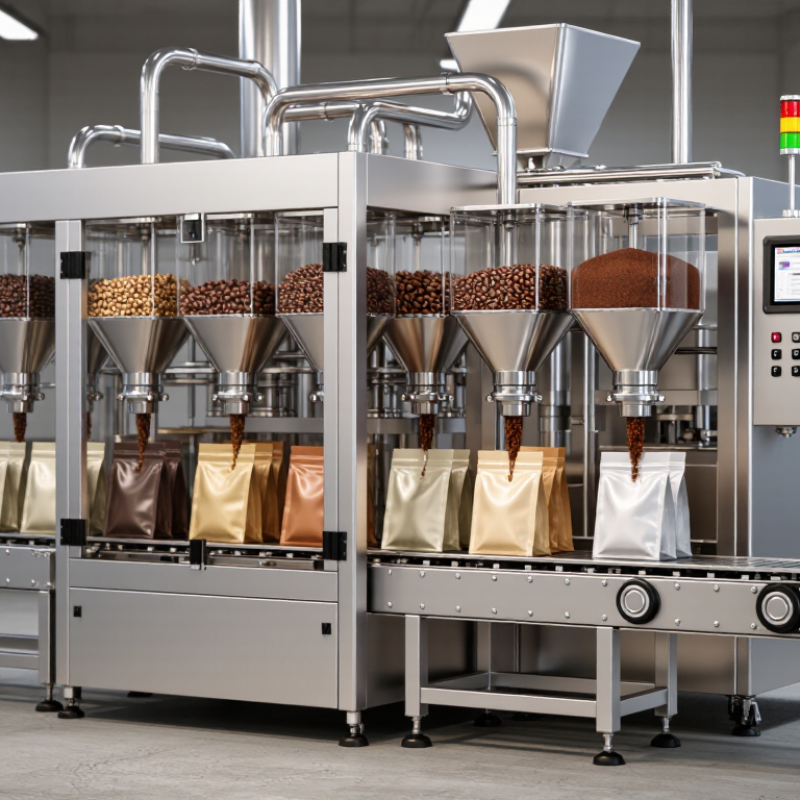
Define Coffee Type, Pack Format, and Output Needs at 30–120 Packs/Min
How to Choose the Best Coffee Packaging Machine?
Define Coffee Type, Pack Format, and Output Needs at 30–120 Packs/Min
Start with the product. Whole beans, ground coffee, and instant coffee require different filling systems. Whole beans flow freely, while fine grounds can bridge inside a hopper and create dust. An auger filler often suits ground coffee, but a multihead weigher may handle larger beans more gently. Test real coffee samples before choosing equipment. Moisture, roast level, and particle size can change accuracy.
Pack format matters just as much. Pillow bags, gusseted bags, vacuum packs, and stick packs need different forming and sealing arrangements. A 250-gram bag may run smoothly at 80 packs per minute, while a heavier vacuum pack may need longer sealing time. Do not trust the headline speed alone. Ask for verified output with your target product, bag size, and seal material. Start with the product.
For a 30–120 packs/min requirement, check the complete line rather than the filler alone. Consider feeding, weighing, nitrogen flushing, sealing, coding, and case packing. A fast filler is useless if the sealer causes frequent stops. Operators should access the hopper, remove trapped grounds, and change film without awkward tools. Dust control also protects sensors and improves workplace cleanliness. Measure actual demand. Buying for 120 packs per minute may be wasteful if orders rarely exceed 45. I have seen production plans change after testing, because small seal defects appeared only during longer runs. That result is inconvenient, but valuable. Reliable selection comes from trials, maintenance records, accuracy data, and realistic staffing assumptions.
How to Choose the Best Coffee Packaging Machine? — Define Coffee Type, Pack Format, and Output Needs at 30–120 Packs/Min
| Coffee Product | Typical Product Characteristics | Recommended Pack Format | Common Fill Weight | Recommended Machine Configuration | Practical Output Range | Key Selection Criteria |
|---|---|---|---|---|---|---|
| Whole Beans | Free-flowing, irregular particles; may release carbon dioxide after roasting. | Premade stand-up pouch, gusseted bag, or flat-bottom bag with one-way degassing valve. | 250 g, 500 g, 1 kg | Multihead weigher or linear weigher with an auger or belt-fed product conveyor; heat sealer; optional valve applicator. | 30–80 packs/min | Use gentle product handling, accurate weighing, dust control, and a sealing system compatible with laminated coffee film. |
| Ground Coffee | Fine, cohesive powder; can bridge, compact, and generate dust during filling. | Premade pouch, side-gusseted bag, flat-bottom bag, or pillow bag. | 250 g, 500 g, 1 kg | Servo auger filler with a dust extraction point; continuous or intermittent heat sealing; optional nitrogen flushing. | 30–70 packs/min | Prioritize auger accuracy, anti-dusting measures, controlled product compaction, and strong, clean seals. |
| Single-Serve Drip Bags | Small portion of ground coffee packed in a filter pouch, often with side hooks or hanging tabs. | Individually wrapped sachet or outer envelope. | 8–15 g | Multi-lane stick or sachet machine with filter-paper forming, dosing, sealing, cutting, and optional outer-envelope packing. | 60–120 packs/min | Check multi-lane synchronization, filter-paper compatibility, small-dose accuracy, and tear-notch quality. |
| Coffee Pods | Measured ground coffee portion sealed between filter media or inside a rigid or semi-rigid pod. | Individual pod with foil or film overwrap; carton or secondary pouch. | 5–14 g | Dedicated pod forming and sealing system with volumetric or auger dosing; optional gas flushing and secondary cartoning. | 40–100 packs/min | Match the machine to pod diameter, filter material, sealing temperature, and required gas barrier. |
| Coffee Capsules | Ground coffee filled into preformed capsules; capsule geometry and material vary by application. | Preformed capsule with foil lid; tray, carton, or multipack secondary packaging. | 5–13 g | Capsule filler and foil-lidding machine with dosing, tamping, sealing, coding, and optional tray loading. | 30–120 packs/min | Confirm capsule dimensions, coffee dose, tamping requirements, lid material, and oxygen-protection targets. |
| Instant Coffee Powder | Light, dusty powder with variable bulk density; may be hygroscopic and sensitive to moisture. | Stick pack, three-side-seal sachet, four-side-seal sachet, or jar. | 1.5–25 g for sachets; 50–200 g for jars | Servo auger filler for powder; multi-lane sachet machine or jar-filling line; optional nitrogen flushing. | 60–120 packs/min | Use sealed product contact areas, dust extraction, moisture-resistant film, and a filler designed for low-density powder. |
| Coffee Blends with Additives | Coffee combined with sugar, creamer, flavor particles, or other ingredients; flow properties can vary by recipe. | Stick pack, sachet, pillow bag, or premade pouch. | 10–100 g | Combination weighing or auger dosing selected according to particle size; independent dosing channels may be required. | 30–100 packs/min | Evaluate segregation risk, particle-size distribution, dust generation, recipe changeover, and cleaning access. |
Related Posts
-
Exploring the Features and Applications of Various Coffee Packaging Machines How to Choose the Best One
-

How to Choose the Best Tray Sealing Machine for Your Business?
-
7 Best Plastic Wrapping Machines for Global Buyers?
-

Top Tips for Choosing a Flow Wrapper Packaging Machine?
-

2026 Top Flow Wrap Machine Innovations and Trends to Watch?
-
Revolutionizing the Food Industry with Advanced Flow Wrapper Packaging Machines