How to Choose a 200kW Soft Starter
Choosing a 200kw Soft Starter involves more than matching a number on a motor nameplate. The starter must suit the motor’s rated current, the driven load, and the expected starting frequency. A pump may accelerate smoothly, while a loaded conveyor can demand higher starting torque. One setting will not fit both. It depends.
A useful selection principle, paraphrased from motor-drive author Austin Hughes’s engineering guidance, is: “Match the starter to the motor, load, and duty—not just the kilowatt rating.” Treat this as a practical summary, not a verbatim quotation. Start by checking the motor’s nameplate current and supply voltage. Then estimate how long acceleration should take. A clamp meter, a clear wiring diagram, and the equipment manual can reveal issues that a catalog table will not. A little detail matters.
This guide explains how to compare current ratings, overload protection, bypass arrangements, and enclosure conditions when choosing a 200kw Soft Starter. It also considers real operating clues: a sharp belt jerk, a dimming workshop light, or repeated thermal trips. These signs do not prove the starter is wrong. They do deserve investigation. A larger unit is not automatically safer; its settings and protections still need to fit the motor and application. Selection should be checked against manufacturer data and reviewed by a qualified electrical professional. Even then, assumptions can miss a hot motor or a heavy restart. That is worth admitting.
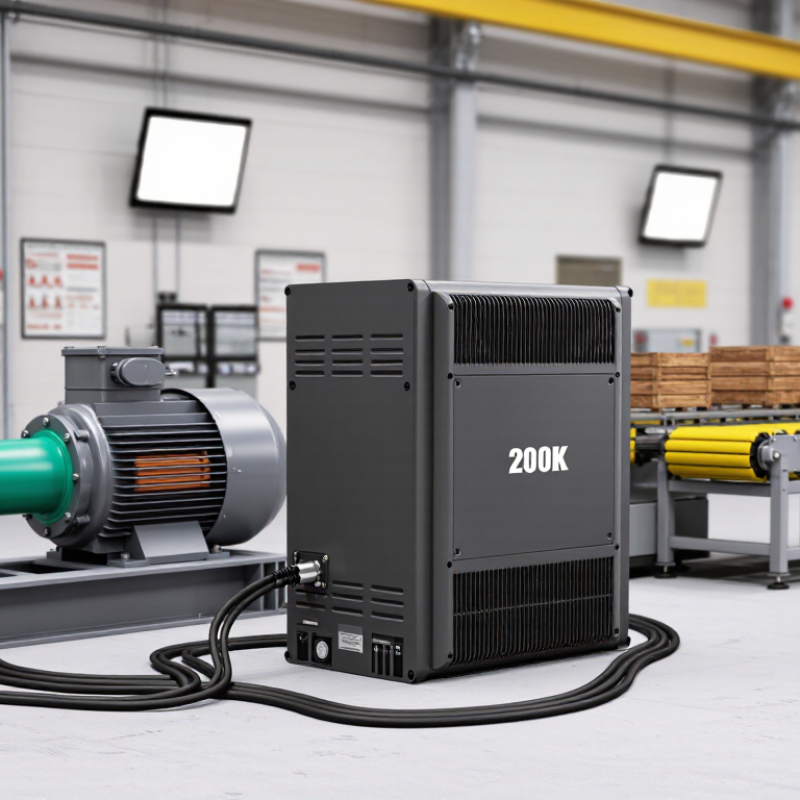
Estimate Full-Load Current: A 200 kW, 400 V Motor Typically Draws 350–370 A
For a 200 kW, 400 V three-phase motor, a practical full-load current estimate is about 350–370 A. This range assumes roughly 90% efficiency and a power factor of 0.87–0.92. Using the three-phase power equation, the lower power factor produces the higher current. Small differences matter. The U.S. Department of Energy’s Improving Motor and Drive System Performance: A Sourcebook for Industry (2014) emphasizes matching motor-system components to actual operating conditions; IEC 60034-1 provides the framework for motor ratings. Treat the estimate as a starting point, not a substitute for the motor nameplate.
Tip: Check the nameplate current before selecting a soft starter. Compare it with the starter’s rated current and starting-duty specifications, not just its advertised kW rating. For example, a starter rated at 350 A may be undersized if the motor plate shows 368 A or the application involves frequent starts. Also confirm supply voltage, enclosure temperature, and expected starts per hour.
The estimate is useful, but imperfect. Efficiency, power factor, and voltage vary between motors and operating conditions. A clamp meter reading during steady, loaded operation can help verify the installation, but it does not replace nameplate data or a proper design review.
How to Choose a 200 kW Soft Starter — Estimate Full-Load Current
At 400 V and a power factor of 0.85, a 200 kW motor draws an estimated 354–369 A when efficiency is between 96% and 92%. This supports the typical 350–370 A range. Confirm the motor’s nameplate current and applicable starting requirements before selecting a soft starter.
Verify Motor Nameplate Data and Ratings Under IEC 60034-1
How to Choose a 200kW Soft Starter
Verify Motor Nameplate Data and Ratings Under IEC 60034-1
For a 200 kW soft starter, check the motor nameplate before comparing kilowatt ratings. IEC 60034-1 sets requirements for motor ratings and performance. Record rated voltage, current, frequency, duty, and connection details. Use rated current as the main selection reference, not kilowatts alone. Confirm the supply voltage and whether the motor is configured for star or delta operation. Do not guess. Also compare actual service conditions with the motor’s stated rating conditions.
Match the starter’s current rating to the real starting duty. A lightly loaded pump can behave differently from a loaded conveyor. Check starts per hour, acceleration time, ambient temperature, enclosure, and bypass arrangements against the starter’s duty data. These details affect permissible operation. The U.S. Department of Energy’s 2014 Improving Motor and Drive System Performance sourcebook estimates that motor-driven systems account for about 68% of electricity use in U.S. manufacturing. That sector-wide figure is not a sizing rule, but it shows why motor-system choices matter. A 200 kW label is only a starting point. I would recheck the current and duty assumptions before approving a selection.
Select Starter Current Rating for the Motor’s Full-Load Current and Duty
How to Choose a 200kW Soft Starter
Select Starter Current Rating for the Motor’s Full-Load Current and Duty
A 200 kW rating alone cannot determine the correct starter current. For a three-phase motor at 400 V, assuming 95% efficiency and a power factor of 0.86, estimated full-load current is about 369 A. This is a planning estimate, not a selection value. Check the motor nameplate; voltage, efficiency, and power factor change the actual current. The U.S. Department of Energy’s Motor Systems Market Assessment emphasizes evaluating motor systems against their real operating conditions, not just their nominal power.
Choose a starter whose rated operational current meets the motor’s nameplate full-load current under the specified installation and duty conditions. IEC 60947-4-2 defines operating conditions for semiconductor motor controllers, while its utilization categories help describe starting duty. Check starts per hour, acceleration time, load inertia, and the time between starts. A loaded conveyor may need a longer ramp and more thermal capacity than an unloaded pump. Ambient heat and a sealed cabinet can also require derating. I would verify the manufacturer’s duty table rather than assume a 200 kW label guarantees a suitable current rating; that assumption is easy to make, and easy to regret.
Check Starting Time and Starts per Hour Against the Motor’s Thermal Limits
How to Choose a 200kW Soft Starter
Check Starting Time and Starts per Hour Against the Motor’s Thermal Limits
A 200 kW rating does not tell you how often a motor can start. Check the motor’s nameplate, duty classification, load inertia, and permitted cold and hot starts. The U.S. Department of Energy’s Improving Motor and Drive System Performance: A Sourcebook for Industry notes that across-the-line starting current is commonly five to seven times full-load current. A soft starter can limit that current, but extending acceleration too far can still heat the motor. The rotor feels it, too.
Start with the actual load. A loaded conveyor may need a longer ramp than an unloaded pump, and repeated starts leave less time for cooling. Compare the proposed starting time and starts per hour with the motor manufacturer’s thermal limits, including ambient temperature and the motor’s previous operating load. Ask for the permitted hot-start figure, not only the cold-start figure. For a 200 kW motor, settings copied from a smaller test motor are a poor shortcut. I have seen this detail overlooked; the calculation can look tidy while the duty cycle is not. Keep a record of real start times and motor temperatures during commissioning. That evidence may change the setting.
Confirm Bypass, Protection, and Compliance with IEC 60947-4-2
How to Choose a 200kW Soft Starter
Confirm Bypass, Protection, and Compliance with IEC 60947-4-2
A 200 kW motor can draw roughly 350 A at 400 V, depending on efficiency and power factor. Treat this as an estimate, not a selection rating; check the motor nameplate and site supply. The U.S. Department of Energy’s 2014 United States Industrial and Commercial Motor System Market Assessment Report attributes about 69% of industrial electricity use to motor-driven systems. That scale makes reliable starting and protection worth careful attention.
Check whether the starter has an integrated bypass contactor or requires an external one. Once acceleration ends, bypassing the power electronics can reduce their heat load. Confirm the bypass’s continuous-current rating, switching arrangement, and suitability for the enclosure’s ambient temperature. Heat matters. A bypass does not replace overload or short-circuit protection. Verify the starter’s motor overload settings and coordinate upstream fuses or circuit breakers with its declared ratings.
IEC 60947-4-2 covers semiconductor motor controllers and soft starters. Ask for test documentation and declared ratings that match the intended supply and duty. Confirm protection against phase loss and overheating where required by the application. A standard reference alone does not prove that the complete installation is correctly coordinated. I would not treat compliance as a checkbox; installation details can still trip up a sound selection. Check the actual wiring diagram and protection study before approving the unit.