
Why Choose Plastic Gears for Industrial Applications?
Plastic Gears are no longer limited to light-duty mechanisms. They operate in pumps, appliances, medical equipment, and automotive systems, where weight, noise, and corrosion matter. A Plastic Gear can weigh less than a comparable metal gear and may run with little or no added lubrication, depending on its material and design. Quiet operation helps, too. In a compact actuator, that can mean less vibration and a softer sound during repeated cycles.
The broader materials industry is substantial: PlasticsEurope’s Plastics—The Fast Facts 2024 report estimates global plastics production at 413.8 million tonnes in 2023. This figure describes plastics overall, not gear production, but it reflects the scale of the material supply chain behind engineered components. Mechanical-design author Robert L. Norton’s work offers a useful principle for gear selection. In paraphrase: “Choose materials for the full operating conditions, not for one appealing property.” That distinction matters. Plastic gears can face creep, wear, moisture changes, and temperature limits. They are not automatic metal replacements. Engineers should check load, speed, duty cycle, lubrication, and operating temperature, then validate the design through testing. Small details count: a warm housing, an unexpected shock load, or a dry-running cycle can change service life. Plastic may be the better choice. Sometimes it isn’t.
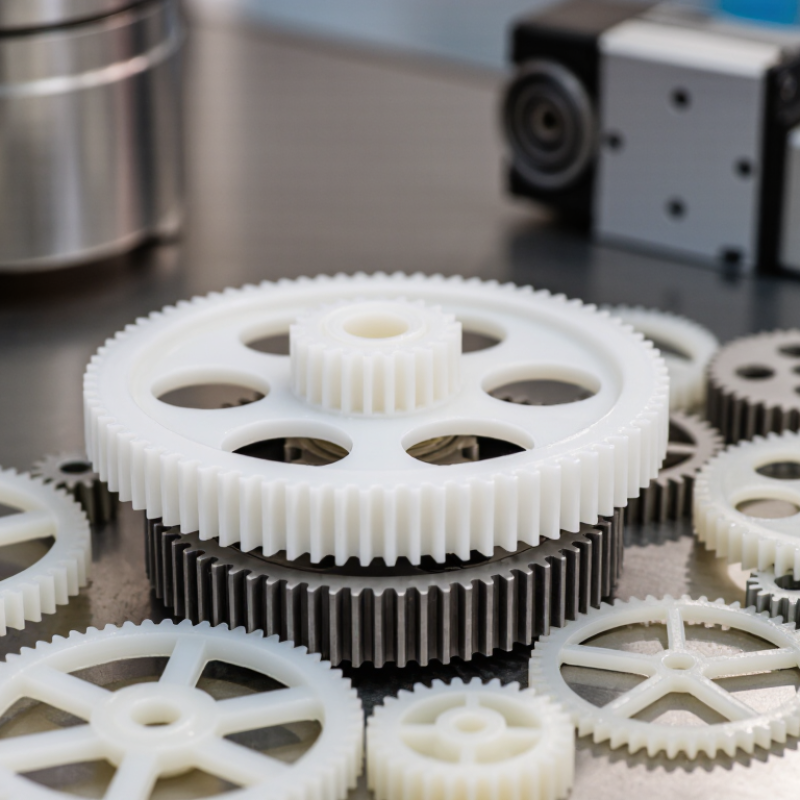
Plastic Gear Fundamentals: Thermoplastics, Tooth Geometry, and Common Types
Plastic gears suit industrial drives where low mass, corrosion resistance, and quieter running matter. Their behavior depends on the thermoplastic, not just the gear shape. Acetal offers good dimensional stability and low friction in many applications. Nylon can wear smoothly, but it absorbs moisture and may change size. High-temperature polymers tolerate harsher conditions, though they are not automatically the best choice. Heat, load, lubrication, and duty cycle all matter. Plastic can creep under constant pressure. That matters.
Tooth geometry controls how smoothly gears mesh and share load. Involute teeth are common because they maintain a steady speed ratio as gears rotate. Module and pressure angle must match between mating gears; backlash needs room for manufacturing variation and thermal expansion. Small errors matter. Spur gears are simple and compact, while helical gears often run more quietly but create axial force. Bevel gears transmit motion between intersecting shafts. Worm sets provide large speed reductions, yet friction can generate heat. A gear may look right on paper and still run hot in a cramped housing. Prototype testing under realistic loads can reveal that awkward surprise.
Material Advantage: POM Density Is About 1.41 g/cm³ vs Steel at 7.85 g/cm³
Plastic’s density advantage is easy to picture in a gear blank. ASM Handbook material tables place common steels near 7.85 g/cm³, while the Polymer Data Handbook lists unfilled POM at about 1.41 g/cm³. At equal volume, a 100 cm³ part weighs roughly 785 g in steel and 141 g in POM. That is about 82% less mass. A lighter gear can reduce rotating inertia and bearing loads, especially in compact drives that start and stop often. Small detail. The hub and tooth roots still need sound design.
The comparison is useful, but incomplete. POM is less stiff than steel and may deform under sustained tooth pressure. Heat, lubrication, and operating cycles also affect service life. A thin POM tooth can flex even when its static strength calculation looks acceptable. Gear designers should check tooth bending, contact stress, creep, and temperature, not density alone. In practical builds, I would weigh the finished gear and inspect wear after a representative duty cycle; handbook figures cannot reproduce a warm, dusty gearbox. POM density varies slightly by grade, and reinforced compounds may be denser. The 1.41 figure is a starting point, not a promise.
Operating Benefits: Lower Mass, Corrosion Resistance, and Reduced Noise
In industrial drives, plastic gears can reduce rotating mass compared with similarly sized metal gears. Less weight matters. A lighter gear may need less energy to accelerate, especially in equipment that starts and stops repeatedly. Reduced inertia can also ease demands on connected components. The actual benefit depends on gear size, material, speed, and load.
Plastic gears resist corrosion in damp environments and around many common washdown chemicals. That can help in pumps, packaging lines, and equipment exposed to moisture. They may also run more quietly because some plastics absorb vibration and soften tooth-to-tooth contact. In a workshop, the difference can be noticeable: less sharp chatter near a compact conveyor drive. Noise reduction is not guaranteed, though. Poor alignment or worn teeth can still produce a rough sound.
Material choice deserves care. Heat, sustained loads, and certain chemicals can affect strength or wear life. A plastic gear that performs well in a lightly loaded actuator may not suit a hot, high-torque gearbox. Check operating conditions, lubrication needs, and supplier test data before specifying one. Plastic is not automatically better; the fit has to be right.
| Operating factor | Potential benefit of plastic gears | Comparison and practical considerations |
|---|---|---|
| Lower mass | Many engineering plastics have a substantially lower density than steel, which can reduce the mass of a gear and its rotating assembly. | Indicative material densities are about 0.9–1.4 g/cm³ for many common engineering plastics, about 2.7 g/cm³ for aluminum, and about 7.8 g/cm³ for steel. Actual component mass depends on material grade and gear design. |
| Corrosion resistance | Plastic gears do not rust, and suitable grades can operate in environments where moisture or some corrosive substances are present. | Chemical resistance varies by polymer and by the substance, concentration, temperature, and exposure time. Metals also vary: stainless steel and protective coatings can provide corrosion resistance. |
| Reduced operating noise | Plastic materials can damp vibration and impact, which may help reduce gear-mesh noise in appropriately designed drives. | Noise depends on the complete system, including tooth geometry, alignment, speed, load, lubrication, and housing. A quieter result is possible, not guaranteed. |
| Design and operating limits | Plastic gears can be useful in applications that benefit from low mass, corrosion resistance, or quieter operation. | Check load capacity, operating temperature, wear, moisture-related dimensional changes, and long-term deformation (creep). The selected material and design must suit the actual duty cycle. |
| Selection note: These are general material-level comparisons. Confirm performance with the specific gear material, geometry, environment, and operating conditions. | ||
Design Limits: Creep, Heat, and VDI 2736 Thermoplastic Gear Rating
Plastic gears can run quietly, but their limits are set by heat and time as much as by peak torque. VDI 2736 Part 2 provides a calculation framework for rating thermoplastic gears, including tooth-root and flank load capacity. It is not a universal load table: material grade, operating temperature, duty cycle, lubrication, and gear geometry all matter. ASM engineering-materials data place many unfilled thermoplastics around 0.1–0.5 W/(m·K) in thermal conductivity, compared with roughly 45 W/(m·K) for carbon steel. Heat therefore leaves a plastic tooth slowly. Creep can then change tooth shape under sustained load, even when the gear never sees a dramatic overload.
Tips: Check the actual material data at operating temperature, not just room-temperature strength. Estimate the heat generated by the real duty cycle, then validate with a representative test. A short bench run may miss long-term deformation; that is an easy limit to underestimate. Record noise, backlash, and tooth wear during testing, and revisit the rating if the housing traps heat. VDI 2736 is a useful design basis, but material-specific test results should still guide final decisions.
Application Selection: Match Torque, Speed, Temperature, and Lubrication
Plastic gears can reduce mass, noise, and corrosion concerns, but selection starts with operating conditions. Measure continuous torque and brief peaks at the shaft, not only motor nameplate torque. Peak loads can bend teeth; sustained loads can deform them through creep. Record speed, starts, reversals, and shock events across a full duty cycle. Small details matter.
The U.S. Department of Energy’s Improving Motor and Drive System Performance: A Sourcebook for Industry reports that motor-driven systems use about 68% of U.S. manufacturing electricity. This is system-level context, not plastic-gear test data, but it highlights why losses and heat should be checked at the real operating point.
Temperature changes polymer stiffness, tooth clearance, and wear. Check the gear’s steady-state temperature, including heat from nearby motors and repeated starts. Do not rely on room-temperature ratings.
Lubrication needs equal care. Some polymers can run dry; others benefit from grease or oil, and compatibility varies by resin and additives. Check lubricant compatibility data for the exact material, then test under load.
A simple rig can reveal noise, backlash growth, wear, and temperature drift after hours of cycling. One caveat: bench tests may not reproduce every shock or contamination event in the field, so review the test conditions carefully.
