
Top 10 WPC Hollow Decking Manufacturers Worldwide
Wpc Hollow Decking can look simple on a showroom floor: hollow boards, clean lines, and a warm wood-like finish. The real test comes later, under sun, rain, shifting temperatures, and regular foot traffic. Wall thickness, profile design, surface texture, and installation requirements all affect how a deck performs. A low price or polished sample tells only part of the story.
For a useful materials-selection lens, this guide draws on Dr. Michael F. Ashby, a materials scientist whose work examines how materials fit their intended uses. A concise paraphrase of that principle is: “Judge a material by the conditions it must handle, not by appearance alone.” It is not a WPC-specific quotation, but it is a practical reminder for comparing products.
The manufacturers in this overview are considered through visible product details, stated specifications, manufacturing capabilities, and support for buyers. Hollow boards may reduce weight, but their internal structure and installation guidance still matter. Small differences can show up at board ends, around fasteners, or after repeated wet-and-dry cycles. I would not treat a smooth sample as proof of long-term performance. The comparison also has limits: product ranges and regional availability change, and published claims deserve independent checking. The aim is a grounded starting point for selecting Wpc Hollow Decking—not a promise that one brand suits every project.
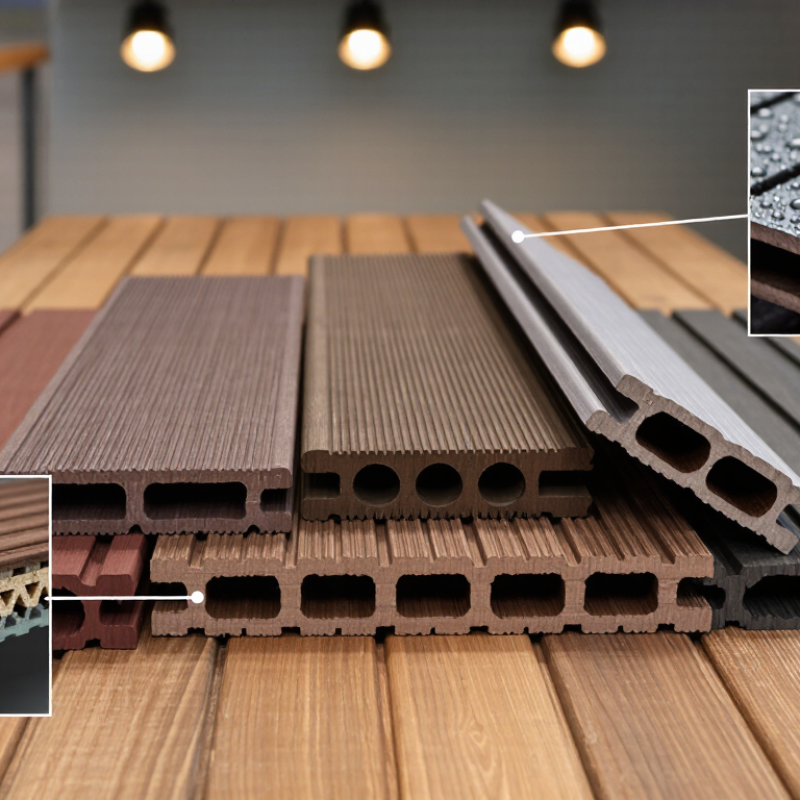
What WPC Hollow Decking Is and How It Is Made
WPC hollow decking is made from wood fibers or fine wood flour blended with thermoplastic polymers and additives. The exact recipe varies by manufacturer, so color and appearance alone cannot reveal a board’s composition. The wood gives the surface a natural-looking grain, while the polymer helps bind the mixture. Hollow chambers run through the board’s length, reducing weight and material use compared with a solid profile. Not every board behaves alike.
Production typically begins by drying and mixing the wood particles with polymer and stabilizing additives. The blend is heated until it can be pushed through a shaped extrusion die. That die forms the deck board and its internal chambers in one continuous profile. Cooling and sizing equipment then helps the board hold its dimensions before it is cut to length. Some products receive a brushed or embossed surface for added texture. Small process changes matter.
The hollow design can make boards easier to handle, but it also makes installation details important. Cut ends may need suitable caps, and the supporting structure should allow water to drain rather than collect inside or beneath the deck. Follow the product’s guidance for joist spacing, fastening, and temperature-related movement; these details differ across profiles. A board that looks sturdy in a sample can still flex if poorly supported. That deserves a second look.
Key Criteria for Evaluating WPC Decking Manufacturers
Choosing a WPC hollow decking manufacturer takes more than comparing prices or attractive product photos. Ask for technical data on material composition, wall thickness, UV stability, water absorption, and stated load capacity. Request test reports and check whether they identify the test method and sample dimensions. Not enough. Hollow profiles differ: thin internal webs can reduce weight but may affect fastening and span performance. Confirm recommended joist spacing and installation details for your climate.
Evaluate production consistency alongside specifications. Ask how batches are tracked, how color variation is checked, and what happens if boards arrive warped or damaged. Read warranty exclusions in plain language, including fading, staining, and installation-related claims. If possible, inspect a full-length sample outdoors; a small indoor swatch may hide texture and color shifts. Compare project references with similar temperatures, moisture, and foot traffic. Claims can sound convincing, but documentation and after-sales support matter more. Even careful checks cannot predict every site condition.
Tips: Request a recent batch sample and install a short test section. Check drainage, expansion gaps, and screw holding. Record unanswered questions before ordering.
Top 10 WPC Hollow Decking Manufacturers Worldwide
A comparison of the top 10 WPC hollow decking manufacturers worldwide should look beyond polished product photos. Check whether each maker publishes clear board dimensions, wall thickness, material composition, and installation guidance. These details affect span, fastening, and how the deck feels underfoot. A sample can reveal surface texture and color variation, but it cannot show how boards perform through years of changing weather.
Manufacturing experience matters, yet published claims need practical checks. Ask for test data on slip resistance, water absorption, and dimensional stability, and confirm what conditions those results represent. Hollow profiles are lighter and often easier to handle than solid boards. However, their internal supports and end caps need suitable protection from moisture and debris. Compare warranty terms, delivery options, and technical support in your region, too. A low price may look attractive; replacement work is less so. Even careful comparisons leave uncertainty, since local installation quality can change the result.
Tips: Request a cut sample and inspect its chambers. Ask how far apart supports should be, and whether the guidance changes for steps or high-traffic areas. Keep a small record of the answers. Details can get missed.
Top 10 WPC Hollow Decking Manufacturers Worldwide
An anonymized overview of established WPC-producing regions and common product characteristics. Entries are not a company ranking; individual manufacturers and product specifications vary.
| No. | Manufacturing Region | Common WPC Decking Profile | Typical Material System | Common Applications |
|---|---|---|---|---|
| 1 | China | Hollow, multi-chamber, and solid profiles | Wood or other plant-based fibers combined with thermoplastic polymers; formulations vary by producer | Residential terraces, balconies, garden paths, and commercial outdoor areas |
| 2 | United States | Primarily solid and capped profiles, with hollow products also available from some suppliers | Wood fiber or flour blended with polymers; some products include a protective polymer cap | Residential decks, pool surrounds, walkways, and outdoor living spaces |
| 3 | Canada | Solid and hollow profiles, depending on the product range | Wood-based filler and thermoplastic resin, with product-specific additives and surface layers | Decks, patios, stairs, and other exterior walking surfaces |
| 4 | Germany | Hollow and solid extruded profiles | Wood fibers or flour combined with thermoplastics such as polyethylene or polypropylene | Terraces, balconies, garden structures, and landscape projects |
| 5 | United Kingdom | Hollow and solid boards, including grooved installation profiles | Wood-polymer composite formulations; recycled content and polymer type vary by manufacturer | Domestic patios, garden decking, balconies, and public walkways |
| 6 | Netherlands | Extruded hollow and solid decking boards | Thermoplastic resin combined with wood fiber or other lignocellulosic material | Residential terraces, waterfront areas, and outdoor commercial spaces |
| 7 | Sweden | Solid and hollow profiles designed for exterior use | Wood-polymer composite; exact fiber, resin, and surface composition is product-specific | Garden decks, balconies, and outdoor areas exposed to seasonal weather |
| 8 | Turkey | Hollow, ribbed, and solid extruded boards | Wood-based filler blended with thermoplastic polymers, with formulations varying by producer | Terraces, poolside decking, garden paths, and hospitality projects |
| 9 | India | Hollow and solid decking profiles | Wood-plastic composite made with plant-based filler and thermoplastic resin | Balconies, rooftop terraces, patios, and landscape applications |
| 10 | Australia | Solid and hollow profiles; availability differs by supplier | Wood-polymer composite, sometimes supplied with a capped or textured outer surface | Residential decks, pool surrounds, boardwalks, and outdoor entertaining areas |
Product Features and Manufacturing Capabilities Compared
Hollow WPC decking should be compared by more than appearance. Check the cavity layout, wall thickness, reinforcing ribs, and cap-layer coverage. These details affect stiffness, weight, drainage, and how cleanly boards can be cut. A well-finished sample may still hide uneven walls. Ask for cross-section images and production tolerances.
Grand View Research’s 2024 Wood Plastic Composite Market report estimates the global market at USD 7.1 billion in 2023, with projected annual growth of 11% through 2030. This broad market figure is not decking-specific, but it signals rising demand for consistent production. Compare manufacturers’ extrusion capacity, co-extrusion options, cooling and calibration controls, and batch testing. Ask how they manage recycled polymer and wood-fiber variation. Small details matter.
Performance claims need evidence. ASTM D7032 covers performance requirements for wood-plastic composite decking, including structural and durability criteria. Request test reports that identify the exact profile and formulation, not just a similar product. Compare span tables, load results, water absorption, and freeze-thaw performance. Published data are often incomplete. That makes supplier comparisons imperfect, so verify samples against the documents before specifying a product.
Top 10 WPC Hollow Decking Manufacturers Worldwide: Product Features and Manufacturing Capabilities Compared
Availability of comparable, source-verified manufacturer data
No source-verified, comparable figures were provided for these product and manufacturing dimensions. The zero values indicate that no figures are available in the supplied material—not that manufacturers have zero capacity or product performance.
Common Applications and Buyer Considerations
WPC hollow decking is commonly used on garden terraces, balconies, pool surrounds, and raised walkways. Its lighter profile can simplify handling on residential projects, while the wood-like surface suits outdoor seating areas. Near pools, check drainage gaps and surface texture; standing water can make maintenance harder. Not every profile fits every site.
Buyer decisions should start with the subframe, not the color. Confirm joist spacing, fastening method, board dimensions, and load guidance in writing. Hollow boards may need closer support than some solid alternatives, depending on their design. Ask how the product responds to heat, moisture, and direct sunlight, and request a physical sample to inspect its finish. Small details matter. Compare replacement availability and warranty conditions, too. A low initial price may not reflect the cost of extra supports or specialized clips. For public or heavily used walkways, seek project-specific technical advice before ordering. Even careful planning misses things; installers sometimes discover that edges need more finishing than expected. That is worth checking early.
